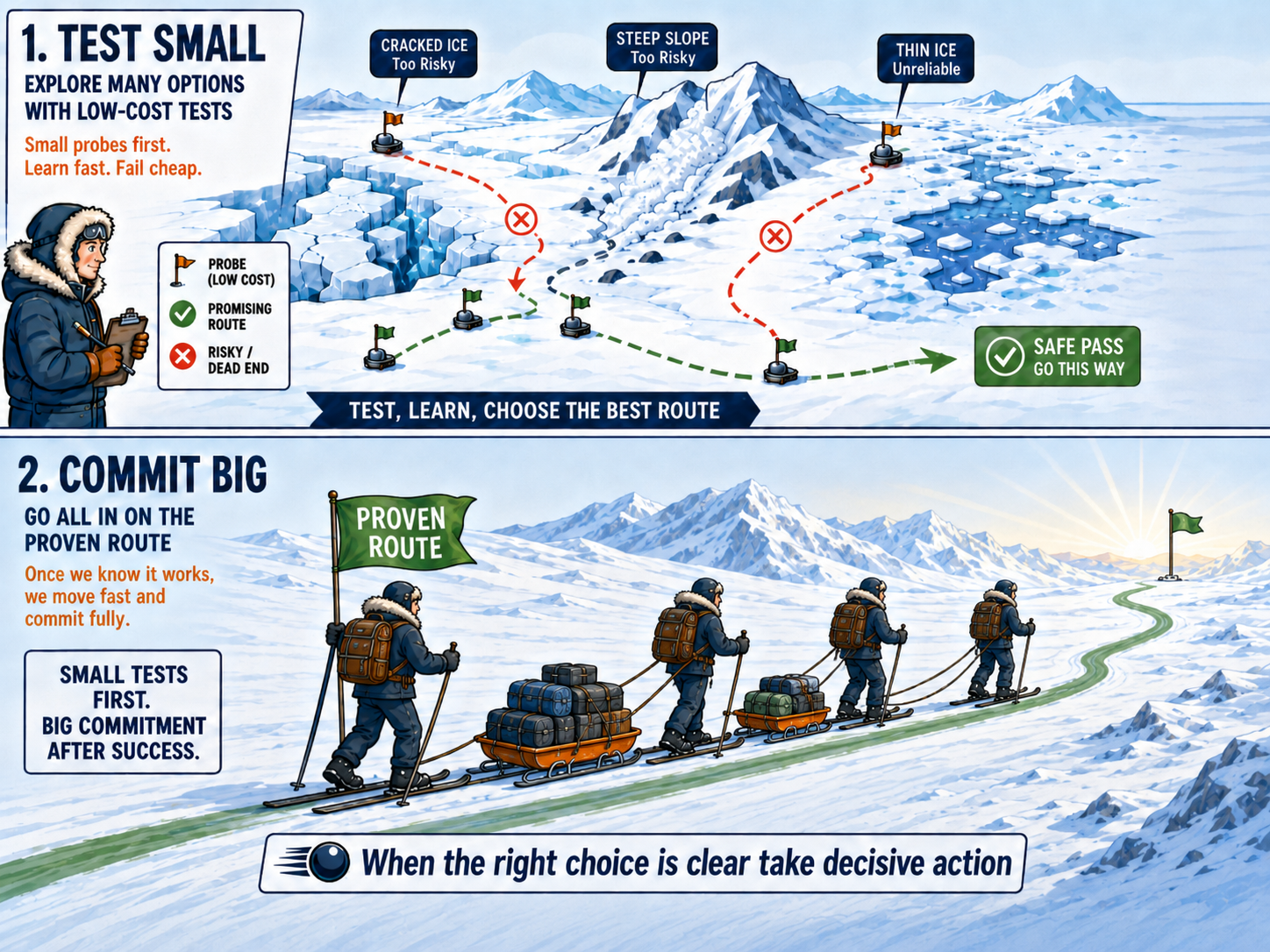
A good Business & Performance approach does not mean building a permanent dashboard for every suggestion. It means keeping a visible portfolio of ideas, deciding what deserves further investment, and scaling only when managers actually use the output to make decisions.
Problem: PathwayOne stores referrals as actions, not cases. The new system’s default count is not automatically the right answer for the service or for NHSE returns.
What I would do: Test OPT-A, OPT-B and OPT-C against a known anchor patient and a full March reconciliation — old system, new default, agreed logic and dashboard — before embedding anything in the warehouse.
Who: Clinical lead on rejected-referral logic; BI on extraction; mandatory reporting owner on NHSE alignment; performance lead on sign-off.
Artefact: Three options and March reconciliation (151 / 168 / 134 / 154).
Benefit: The agreed figure is defensible in a directorate workshop, not “whatever the feed produced”. After six months: The decision log and reconciliation method transfer to the next definition dispute.
Problem: Mandatory returns can be submitted on legacy logic while local teams have already moved to a new model — then NHSE query arrives months later.
What I would do: Build the submission from the same episode fact as local products, run pre-submission validation checks, and compare agreed OPT-C to what the dashboard would have submitted.
Who: Mandatory reporting owner, BI lead, finance on activity alignment where relevant.
Artefact: MHSDS-like mock submission with VAL-MH checks and reconciliation summary.
Benefit: Submit 134 when agreed, not 154 because the dashboard refreshed. After six months: Inclusion rules and checks are documented, not tacit.
Problem: A full lineage map is overwhelming for service managers; a static PDF goes stale the week after export.
What I would do: Test preset filters (mandatory vs local, low-confidence, migration-risk rows) with CMHT leads in short walkthrough sessions — do they answer real questions without BI translation?
Who: Two CMHT leads for pilot feedback; BI maintains the underlying CSV; performance lead facilitates the sessions.
Artefact: Interactive source-to-report map with filter presets.
Benefit: Managers can follow a figure back in one sitting. After six months: Filters become the standard onboarding tool for new report owners.
Problem: Service managers juggle several spreadsheets for referrals, waits, workforce and agency — none aligned on the same definition in migration month.
What I would do: Prototype one weekly pack with two CMHT leads for six weeks; compare meeting quality and decision speed against their old spreadsheet routine; dismiss a naive forecast when it overshoots 18% during definition change.
Who: CMHT service managers, workforce lead, finance BP on agency lines.
Artefact: Demand, capacity and productivity insight (promoted from pilot — IDEA-01).
Benefit: One shared view for capacity conversations; INS-03 stopped a misleading forecast reaching the Board. After six months: Pack owned by performance lead with CMHT sign-off, not a secondment side project.
Problem: Risk register, validation outputs and confidence model told the same story three different ways — sponsors read one page and miss the publish gate.
What I would do: Merge three registers into one narrative (risks → checks → publish decision), review with BI and performance leads, then promote as the single assurance product.
Who: BI lead, performance lead, directorate sponsor for sign-off on withhold rules.
Artefact: Reporting assurance during migration (IDEA-02 promoted).
Benefit: Clearer “what we published and what we withheld” story for March 2026. After six months: One assurance rhythm replaces three overlapping registers.
Problem: Good suggestions become permanent reports by default; failed pilots linger as “work in progress” with no honest stop.
What I would do: Keep a visible register of promoted, under test, parked and dismissed ideas — including manager 1:1 guides, DNA recovery pilots and statistical forecasting parked until data is clean.
Who: Performance lead curates; service managers and HR BP co-own people-focused pilots; BI supports data tests only where needed.
Artefact: Full ideas under test portfolio with plain-English test descriptions.
Benefit: Panel and directors see judgment, not just output volume. After six months: Register shows what to sustain, what to park and what not to repeat.